





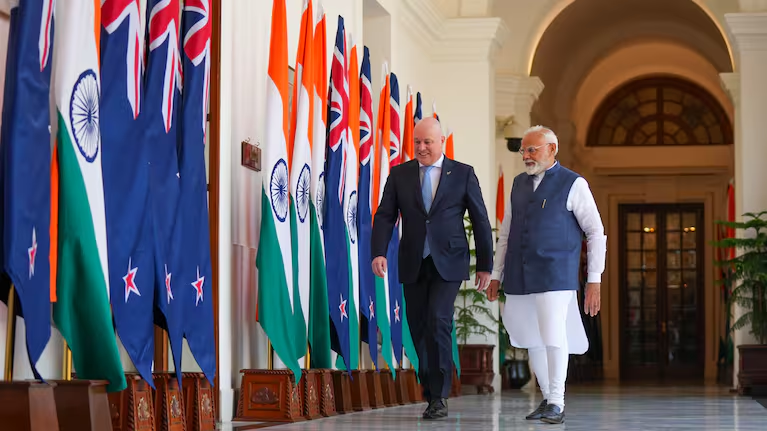
NZ–India Free Trade Agreement: Opportunities for Canterbury Exporters and Service Businesses
On 22 December 2025, New Zealand and India concluded a landmark Free Trade Agreement (FTA) following just nine months of fast-track negotiations. The agreement represents one of New Zealand’s most commercially significant trade deals in decades, unlocking improved access to one of the world’s fastest-growing economies.
For Canterbury businesses particularly those in agriculture, food processing, manufacturing, education and services, the agreement opens the door to new markets, greater resilience and long-term growth.
🤝 What the NZ–India FTA Delivers
At its core, the agreement dramatically reduces trade barriers between the two countries:
- Around 95% of New Zealand exports to India will receive tariff-free or substantially reduced access
- Over 50% of exports face zero tariffs from day one, increasing to 82% once fully phased in
- New Zealand exporters gain access on an equal or better footing than competitors such as Australia, the UK and Chile
India’s economy is projected to reach NZ$12 trillion by 2030, with a rapidly expanding middle class expected to exceed 700 million people. For New Zealand businesses, this agreement provides scale, certainty and long-term opportunity.
🏙️ Key Benefits for New Zealand Exporters
Improved Market Access Across Core Sectors
The FTA delivers meaningful gains across a wide range of goods and services:
- Agriculture and food: Sheep meat, wool, forestry products, seafood (including mussels and salmon), fruit (kiwifruit, apples, cherries and blueberries) and wine all benefit from improved access
- Mānuka honey: Tariffs reduce from 66% to 16.5% over five years — the first time India has granted preferential access for this product
- Dairy: High-value dairy ingredients and infant formula gain tariff-free or sharply reduced entry
- Manufacturing: Reduced duties improve competitiveness for engineering, machinery and metal products
Services, Skills and Mobility
The agreement also strengthens services trade and workforce mobility, including:
- Coverage across finance, IT, education, e-payments and fintech
- New skills visa pathways (approximately 1,667 annually)
- 1,000 working holiday visas for young Indians
- Post-study work visas supporting education exports
Faster, More Predictable Trade
- Streamlined customs processes
- 24–48 hour clearance for perishables and express shipments
- Reduced red tape for exporters navigating the Indian market
📈 What This Means for Canterbury’s Economy
Canterbury is particularly well positioned to benefit from the NZ–India FTA, given the region’s sector strengths and export profile.
Agriculture & Horticulture
- Value-added dairy products such as cheese, yoghurt and infant formula gain stronger access, supporting Canterbury’s high-margin processors
- Tariff relief for apples, cherries, blueberries, and persimmons strongly supports Canterbury’s horticultural strengths, while kiwifruit and avocados remain key products for other regions
Food Processing & AgriTech
- Tariff elimination on processed foods, cereals, coffee and spices enhances competitiveness for Canterbury food manufacturers
- New centre-of-excellence frameworks for apples, honey and kiwifruit create opportunities for Canterbury-based agritech innovation, R&D and collaboration
Manufacturing & Exporters
- Forestry and wood products receive immediate tariff relief, supporting a key regional export sector
- High-tech manufacturing — including engineering, machinery and specialised metal products — benefits from reduced duties and improved logistics access into India
Education, Services & Tourism
- Student mobility and post-study work pathways support Canterbury’s education providers
- Stronger services links in IT, agritech and professional services create new export opportunities for Canterbury firms expanding into India
- Increased people-to-people connections support longer-term tourism and business relationships
🚀 What Canterbury Businesses Should Do Next
The NZ–India FTA is not just a policy milestone, it is a commercial opportunity. Businesses that act early will be best placed to build relationships, understand market entry requirements and capture first-mover advantage.
Business Canterbury can support members to:
- Understand how the agreement applies to your products or services
- Navigate export documentation and compliance
- Connect with trade insights, events and expert advice
- Build capability and confidence in international markets
📚 Useful External References
- New Zealand Ministry of Foreign Affairs and Trade (MFAT) – NZ–India FTA overview
- New Zealand Government Beehive announcements
- Government of India Ministry of Commerce and Industry - Factsheet (PDF)
Additional Resources:
Thinking about exporting to India — or expanding your presence there?
Explore Business Canterbury’s Global Trade support, including export documentation, trade insights, training and expert advice.
👉Talk to our Global Trade team 📞 Phone: 0800 50 50 96or 📤Email us