






Global Trade Outlook 2026: What Canterbury importers and exporters need to know
Global trade conditions shifted dramatically in the weeks leading up to Business Canterbury’s Global Trade Outlook 2026, with escalating tensions in the Middle East reshaping economic forecasts, energy markets, and shipping routes almost overnight.
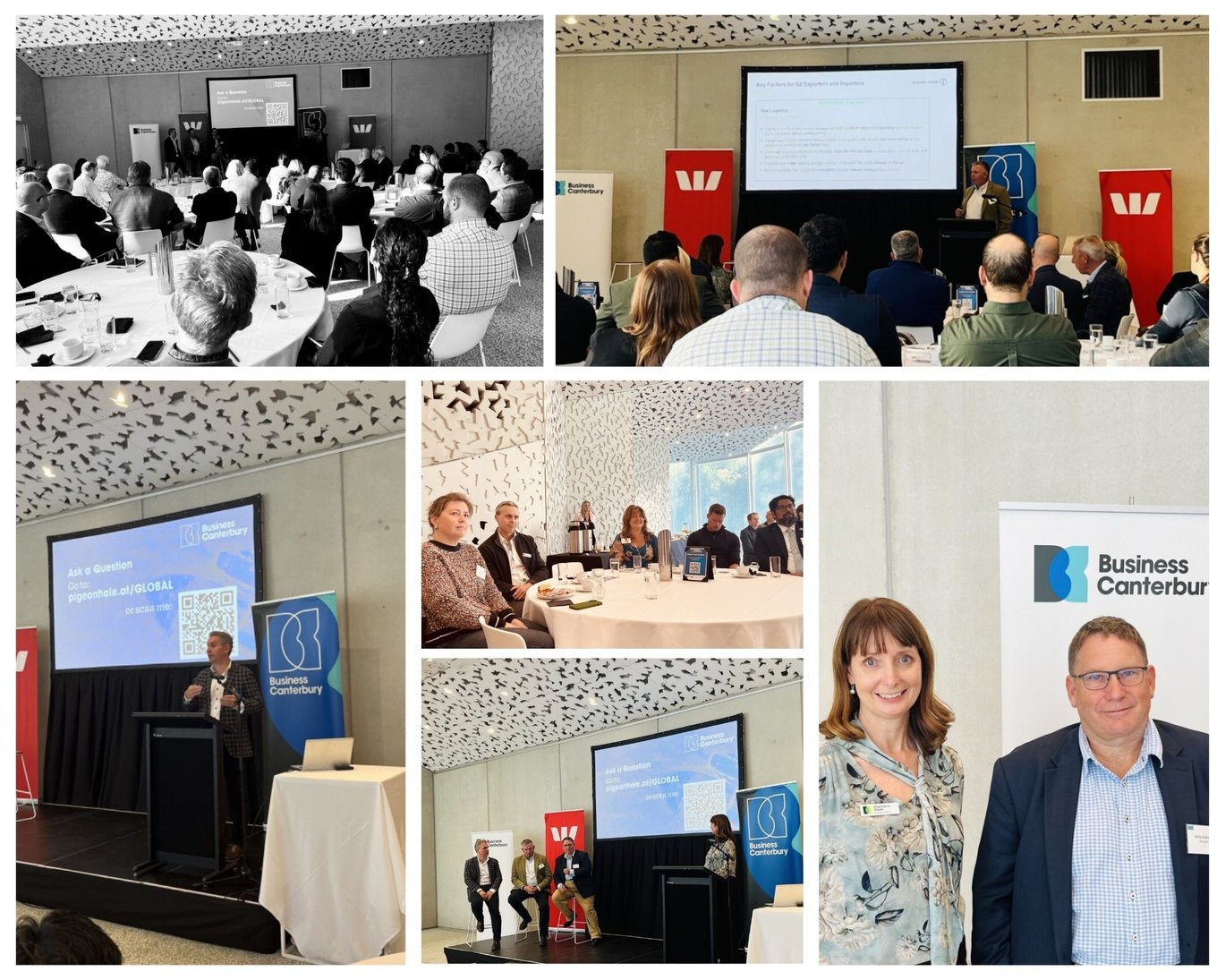
Held on 17 March 2026, the event brought together importers, exporters and global trade leaders to unpack the rapidly evolving outlook for international markets.
Speakers included Kelly Eckhold, Chief Economist at Westpac, Simon Wilson from Kuehne+Nagel, and Craig Carr, Group Managing Director of Carrfields, who shared economic analysis, logistics insights and real-world lessons from building export markets offshore.
Together, they explored what the latest global developments could mean for fuel prices, shipping networks, inflation, currency movements and supply chain resilience, and what practical steps Canterbury businesses should be considering now.
A global economy reshaped in weeks
When Kelly Eckhold first prepared his economic outlook for 2026, the global picture was relatively positive. Growth forecasts across major economies were trending upward, supported by strong commodity prices, rapid investment in artificial intelligence infrastructure, and increased defence spending in Europe.
But the escalation of the Persian Gulf crisis forced a major revision to those forecasts.
“My presentation changed almost entirely in the last two weeks,” Eckhold told attendees.
The closure of the Strait of Hormuz, through which around 20% of global energy supply typically flows, has created immediate disruption to energy markets and global shipping routes.
For New Zealand, the impacts are already beginning to flow through:
- GDP growth forecast revised from 3.3% to 2.8%
- Unemployment expected to rise to around 5%
- Inflation now likely to sit in the low 3% range for several quarters
Oil prices have moved above US$100 per barrel, with petrol potentially heading towards $3.10 per litre and diesel approaching $2.85 per litre.
While New Zealand currently holds about 50 days of refined fuel supply, the long supply chain from the Gulf to Asia means the full impacts may take several weeks to be felt.
“This is a classic supply shock,” Eckhold said. “It pushes inflation higher while slowing growth at the same time.”
Shipping networks under pressure
The ripple effects are already being felt across global logistics networks.
Simon Wilson from global freight forwarder Kuehne+Nagel outlined the scale of disruption currently affecting shipping routes and container flows.
Approximately 132 container vessels — representing around 500,000 TEU of capacity — are currently stranded in the Gulf region, while shipping lines have declared force majeure on cargo bound for several Middle Eastern destinations.
Cargo is being diverted to alternative ports such as Oman and Khor Fakkan, but moving containers onwards can be extremely expensive.
“Getting a container from Jeddah into the UAE or Dubai is currently costing between US$7,000 and US$10,000,” Wilson said.
Emergency fuel surcharges are now being introduced across many shipping routes, often with varying pricing structures between carriers.
At the same time, the Red Sea corridor — which had only recently begun reopening — has effectively closed again, preventing the additional shipping capacity many exporters were expecting.
For many businesses, this means rising costs, longer transit times, and greater uncertainty across global supply chains.
Lessons from building an export market in India
While much of the discussion focused on current disruption, attendees also heard practical insights from Craig Carr on building a successful export presence in India, a market now gaining renewed attention following the recent New Zealand–India Free Trade Agreement., whose company Carrfields has spent more than a decade building a successful presence in India.
Today, more than half of Carrfields’ vegetable seed sales come from India, where the company holds a market-leading position in hybrid beetroot varieties.
Carr emphasised that succeeding in international markets requires patience, deep local understanding, and strong on-the-ground capability.
“India isn’t one market — it’s many markets,” he said. “You have to understand the specific regions and how business works in each of them.”
Key lessons from Carrfields’ experience included:
- establishing a clear long-term purpose in market
- securing strong legal and financial advice locally
- protecting intellectual property
- and ensuring trusted people are on the ground
The company also learned the importance of building redundancy in leadership, after a medical emergency involving its India manager during COVID exposed the risks of relying on a single key person.
Looking ahead, Carr sees significant potential from the New Zealand–India Free Trade Agreement, particularly in sectors such as vegetable seed where demand continues to grow.
What exporters should be thinking about now
While the current situation remains fluid, several practical themes emerged during the discussion.
Businesses operating in global markets should consider:
- reviewing customer contracts to ensure surcharge provisions are clear
- checking freight insurance coverage, particularly for higher-risk shipping regions
- communicating early and transparently with customers about cost changes
- evaluating alternative routes or suppliers where possible
- and continuing to diversify markets and customer bases
The recent disruption reinforces the reality that global trade is becoming more volatile and interconnected, with geopolitical events quickly cascading through supply chains.
“Clear communication with customers and strong contract terms are what help businesses navigate disruption and come out stronger,” Carr said.
What happens next?
Businesses operating in international markets are encouraged to continue monitoring developments closely as the situation evolves.
Attendees were also invited to join the MFAT Middle East briefing later this week for further updates on the regional situation.
Business Canterbury will continue providing global trade briefings and practical insights to help businesses navigate an increasingly complex trading environment.
If you’d like to stay informed about upcoming global trade events and resources, you can subscribe to Business Canterbury updates or join our Global Trade membership network.
For the latest Middle East updates from Kuehne + Nagel, read more insights on their website here, and visit seaexplorer.com.
Keep an eye out for more Global Trade and Ministerial events from us to keep you informed. You can find them on our What's On Page.
Thanks to our event partners