






Breaking Up Businesses Makes Headlines but Building Competition Delivers Results.
If more competition is the answer to cost pressures in New Zealand, structural separation of private businesses, announced as campaign promises by both Labour and National over the last week, is absolutely not the right tool.
The real structural challenge for competition in New Zealand is not the ownership structure of individual businesses, it is our small population, dispersed customer base and complex geography. Those factors create persistent supply chain costs and reduce the attractiveness of our market for new competition, whether it be home grown or imported, particularly in industries operating right across the country where scale and market size matter more.
If we want to do more than simply rearrange the deck chairs on genuine cost pressures facing the economy, then we have to ask the right questions.
A good question might be what the most effective levers are a government can pull to both increase competition, and at the same time support business confidence and economic growth over the long term.
The answer is not breaking up private businesses without a clear understanding of the costs and benefits. The focus should instead be on addressing the underlying factors that make New Zealand an expensive place to operate and a difficult place for new competitors to enter.
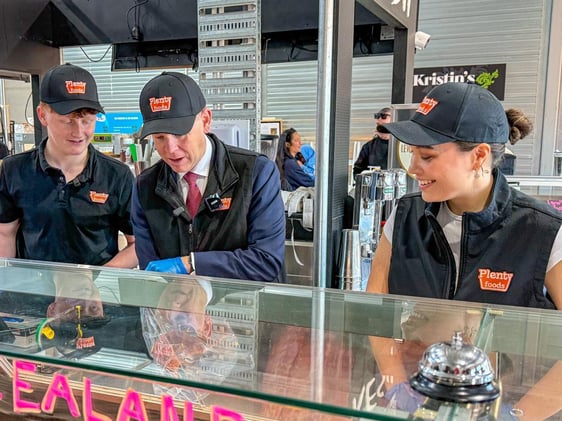
Labour leader Chris Hipkins, along with his spokesperson for commerce and consumer affairs, Arena Williams, try their hand at grocery retailing on the election trail. Photo: Henry Cooke
That means investing in the infrastructure and policy settings that reduce supply chain costs and make New Zealand one of the most attractive places in the world to start, grow and invest in a business.
Businesses consistently tell us that what they need is regulatory certainty, efficient infrastructure and confidence in the rules of the game, not the prospect of governments deciding how lawful private businesses should be structured.
The case for infrastructure investment as a driver of competition is straightforward. For some of our members, it is more expensive to move goods from one end of New Zealand to the other than it is to ship them overseas. A delayed or cancelled Cook Strait ferry crossing can create supply chain disruption that takes months to work through. An accident on the Rakaia Bridge can lead to six to nine-hour delays on State Highway 1 at one of the most critical points in the country's freight network, and only months ago more than 200 kilometres of State Highway 1 were closed following severe weather, with some sections shut for more than a week.
Every one of those events adds cost and a disincentive for competition. Those costs are ultimately borne by consumers through the price of groceries, building materials, freight and countless other goods and services.
When transport networks are unreliable and operating costs are high, businesses often require greater scale and efficiency simply to remain viable. That raises the barriers to entry for new domestic competitors and makes the market less attractive for international investment. If we can make our supply chain more reliable and less expensive – it becomes a much different conversation for potential competitors to enter a market.
Capital also matters almost as much as physical infrastructure. Every distribution centre, processing plant, truck fleet, cool store and new business is generally funded by shareholders, investors or banks. They assess risk carefully, and the cost of capital reflects the level of certainty they have about the future.
A country willing to legislate the restructuring of lawful private businesses creates greater uncertainty for them. That uncertainty carries a cost, and that cost ultimately flows through the economy in exactly the same way as supply chain disruption – it would end up being paid by consumers.
Then let’s look at market attractiveness. If New Zealand genuinely wants to encourage more competition, then it should be the best place in the world to start, build and invest in a business. The last signal we should be sending is that major political parties are willing to reach for structural separation as a first response to concerns about prices or market performance.

The future is looking murky for the supermarket sector, with major political parties promising significant shake-ups of the businesses behind our grocery supply. Photo: David White
It opens a Pandora's box that would be difficult to close. Once potential competitors in any industry begin to question whether the structure of the businesses underpinning their investments could change with the political cycle, confidence will disappear.
A better approach is to focus on policies that support growth, productivity and efficiency. That means reducing unnecessary compliance costs, improving infrastructure resilience and the cost of its delivery, streamlining regulation and providing businesses with confidence that investment will be rewarded rather than penalised.
It means sending a clear message to potential domestic and international competition that while New Zealand may be a small market, it is a stable, predictable and attractive place to do business.
So, if the goal is more competition to lower costs, we should focus on the barriers that prevent competition from emerging in the first place. New Zealand cannot change its geography or population base, but it can improve its infrastructure, strengthen its supply chains and create the conditions that attract investment and new competition. Those are the reforms that will deliver lasting competitive pressure in key sectors.
Breaking up existing businesses may create headlines but making New Zealand easier and cheaper to do business in is what will create genuine competition and better outcomes for consumers over the long term.